
For too long, equity, diversity and inclusion (EDI) have been treated as an optional extra at the end of a board meeting. But as a solicitor working within the cultural sector, I see it differently. EDI is not a matter of aesthetics; it is a fundamental pillar of sound governance.
When I was invited by the Cultural Governance Alliance (CGA) to author its new EDI benchmark for boards, my objective was to move the conversation away from vague intentions towards structural accountability.
In any other area of governance — finance, health and safety, or data protection — a board that operates without a full set of facts is considered a liability. Yet many boards of cultural organisations continue to make high-stakes decisions while operating within a demographic echo chamber.
If a board does not reflect the community it serves, it suffers from a collective blind spot. It misses risks, misinterprets opportunities and, ultimately, fails in its fiduciary duty to ensure the long-term resilience of the organisation. Diversity is often discussed in terms of "lived experience", but in the boardroom, it is also about "cognitive diversity". It is the best defence we have against groupthink.
We have often heard the phrase "the arts are for everyone". However, without a framework to measure that claim, it remains a slogan rather than a strategy.

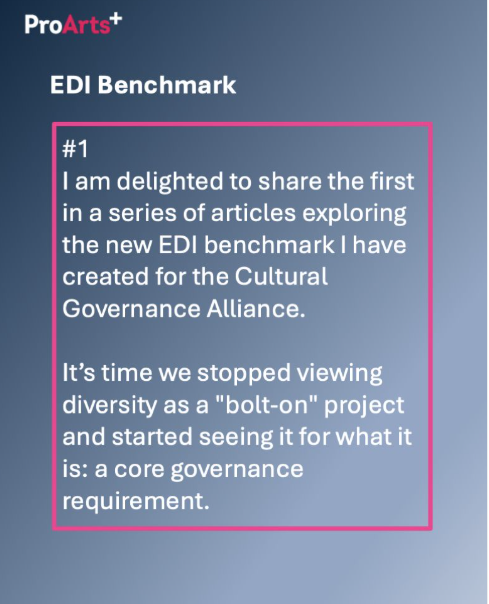
The CGA benchmark was designed to provide boards with a mirror. It asks the difficult questions that are often avoided:
- Who is missing from this table, and why?
- Are our recruitment processes legally robust and genuinely inclusive?
- Is our culture one where a dissenting, diverse voice can actually be heard?
The goal of this work is to transition the cultural sector from a state of "performative compliance" — where we tick boxes to satisfy funders — to a state of "active governance".
We cannot fix what we do not measure, and we cannot lead what we do not understand. If we want the UK’s cultural institutions to remain relevant in the 21st century, the change must start with the people who hold the ultimate responsibility: the trustees.
The goal of this work is to transition the cultural sector from a state of "performative compliance" — where we tick boxes to satisfy funders — to a state of "active governance".
We cannot fix what we do not measure, and we cannot lead what we do not understand. If we want the UK’s cultural institutions to remain relevant in the 21st century, the change must start with the people who hold the ultimate responsibility: the trustees.